


Table of Contents
Cable management kit home office solutions are transforming how we work, making remote workspaces safer, tidier, and more professional. If you’re tired of tangled cords and overwhelming desk clutter, you’re not alone. In this guide, you’ll find realistic strategies, step-by-step instructions, and honest pitfalls to avoid, all backed by the latest 2024 market and user research.
Key Takeaways
- Modern cable management kits for home offices address both aesthetics and safety, responding to explosive demand as remote work grows.
- Common mistakes—like using weak adhesives or undersized trays—still frustrate users, but smart kit selection and setup can prevent most issues.
- Premium features such as fire-resistant materials and ventilation, though not always advertised, are increasingly critical for home office safety.
The Core Concept
A cable management kit for a home office is a collection of components—like trays, cable raceways, clips, sleeves, and boxes—that help organize, conceal, and secure the hundreds of inches of wiring now typical at most work-from-home desks. The “why” is simple: the average home office now supports several monitors, networking hardware, phones, and smart devices, multiplying cable clutter while increasing risks related to accidents, fire, and equipment damage. This surge in demand is reflected by a global cable management market worth over $23 billion in 2024, with home office products leading sector growth at 9-12% yearly (source).

Kits designed for home offices do more than just relocation—they actively reduce trip hazards, improve workspace aesthetics, and can even lower fire risk with ventilated boxes and fire-rated plastics. Choosing the right kit tackles not just mess but safety, productivity, and peace of mind, especially important if your workspace doubles as a living area.
For more insights on holistic home organization, our home office renovation guide explores how dedicated setups boost productivity.
Step-by-Step Guide
Here’s a direct, field-tested approach to installing a cable management kit home office setup that tackles the real causes of clutter and ongoing maintenance headaches.
- Sort and label all cables: Unplug everything, group by device type (power, video, USB, network) and label both ends for easy future changes. Color-coded Velcro ties speed reconfiguration.
- Plan your routing: Identify routes for each cable type. Prioritize keeping power and data lines separated where possible to reduce interference.
- Mount cable trays or baskets under the desk: Place trays as close to the back edge as possible, but not so deep that you’ll jab your knees. For standing/adjustable desks, ensure enough cable slack for up/down movement.
- Secure raceways: Use screw-in mounts as your first choice—adhesives fail most often. Only use included adhesive on truly smooth, clean, finished surfaces. Modular raceways simplify future cable additions.
- Bundle and sleeve cables: Group cables by endpoint and slip into braided or neoprene sleeves. Avoid mixing thick power bricks with thin data wires to simplify troubleshooting.
- Install cable clips and grommets: Fasten clips near the front desk edge to keep charging and headphones cables where you can grab them easily.
- Hide power strips in ventilated boxes: Place boxes close to outlets to minimize visible AC cord runs. Ensure adequate airflow to prevent heat buildup, especially with several large power adapters.
- Final visibility and safety check: Sit or stand at your usual positions. Reposition any pieces still showing clutter. Periodically check all mounts over the next month for looseness or early adhesive failure.
For deeper organization projects, our guide to easy DIY home projects offers inspiration for maximizing small spaces.
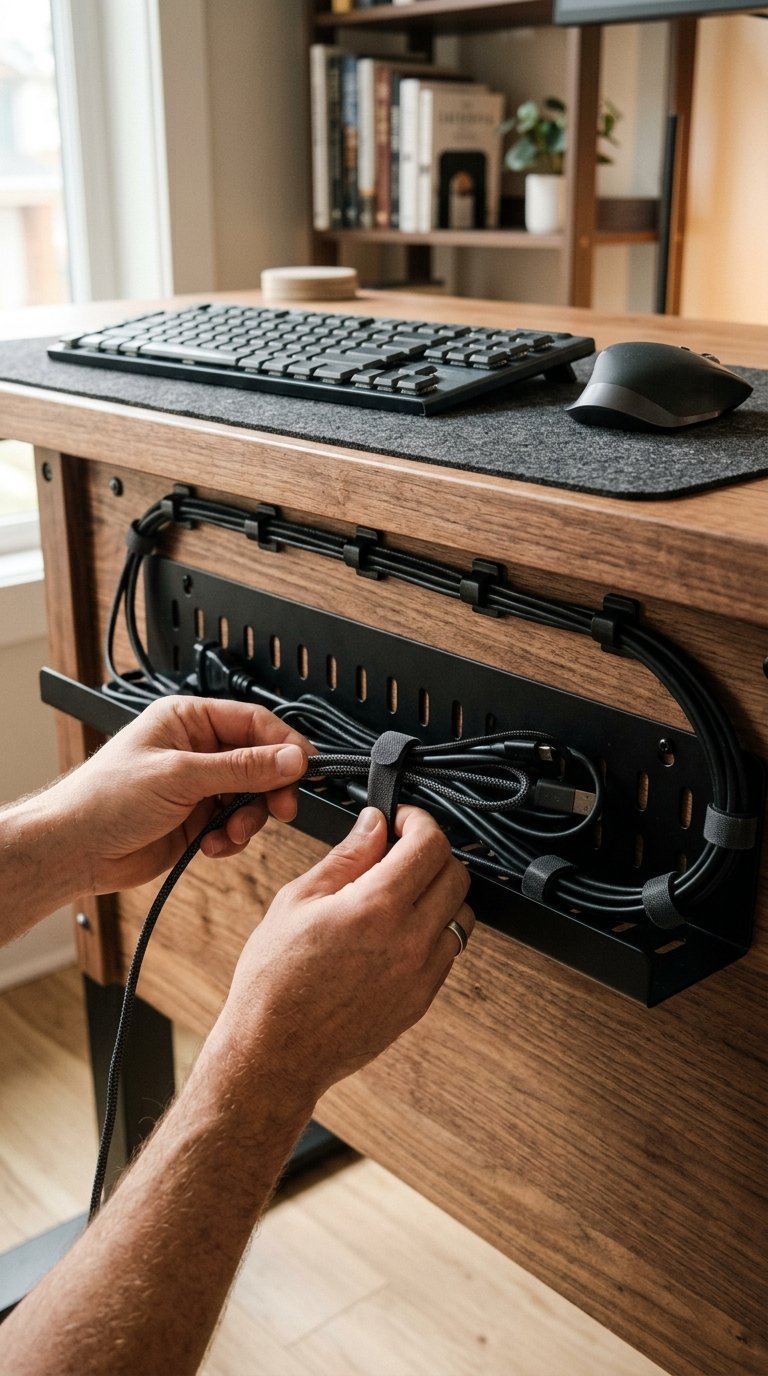
Maintenance tip: Set a calendar reminder every 3-6 months to review your cable needs, especially if you upgrade tech often. Systems that are hard to open or require removing screws for every change will eventually cost you time and frustration.
Want an even cleaner look? If your desk supports it, consider integrated power modules or vertical cable “spines”—these features are increasingly common in high-end setups, as discussed in our kitchen island upgrade guide (where hidden cable management is trending).
Advanced Analysis & Common Pitfalls
Even with premium cable management kits, users frequently run into avoidable (and costly) problems. Here’s a research-driven look at common pitfalls and how to dodge them.
- Adhesive failures: Adhesives on trays and raceways often fail, especially on textured or dusty desks. Always test adhesives for 24 hours before bundling heavy cables.
- Insufficient capacity: Kits labeled “large” may not fit all your equipment—especially surge protectors or power-hungry laptop bricks. Underestimating cable count or not accounting for thick cords packs trays too tight, making future upgrades a hassle.
- Incompatible components: Not all kits work with thin, curved, or standing desks. C-clamps offer more flexibility, but may interfere with sit-stand mechanisms or desk crossbars.
- Poor ventilation and thermal buildup: Many cable boxes trap heat and lack exhaust slots. When multiple adapters run together, internal temperatures can rise, increasing fire risk. Choose kits with visible vents and check for UL or flame-retardant material ratings (see market data).
- Insufficient accessories: Budget kits may lack clips, ties, or enough raceway length, forcing additional purchases and reducing value.
- Mismatched aesthetics: Many kits look sleeker in photos than in reality. Plastic parts can appear flimsy, and hardware may remain visible from normal seating—especially under glass desktops.
- Mess relocation: Some “solutions” just shift clutter from desk to floor, especially if power strips stay visible or cable exits are not planned. True tidiness requires combining multiple component types (tray, box, clips, sleeves, grommets).
| Aspect | Budget Kits | Premium Kits |
|---|---|---|
| Materials | Basic plastic or thin metal; low fire resistance | Heavier steel, UL-listed fire-retardant plastics |
| Mounting | Adhesive (weak), basic screws | C-clamps, robust screws, flexible placement |
| Capacity | Too small for surge protectors and thick cables | Fits full-size power strips, modular expansion |
| Ventilation | Poor; may trap heat | Ventilated; safer for power adapters |
| Maintenance | Hard to reconfigure; breakage risk | Easy access; tool-less options |
| Complete Solution | Often missing key parts (clips, grommets) | Includes all pieces needed for modern desks |
Looking for a smart-tech edge? Offices are trending toward smart home integrations—solutions like desk power modules with built-in USB and cable exits can streamline your charging needs alongside cable management.
If you need to blend utility with aesthetics, custom approaches are also gaining ground. Learn more about visually integrated solutions in our ideas for seamless indoor upgrades.

Cost is an unavoidable factor. Budget all-in-one kits start around $10–25 but may require upgrades. More complete, durable kits range $30–60 or more, while designer and integrated options can climb well past $100 (industry data). Prioritizing safety, capacity, and flexibility often justifies a higher upfront investment.
Want to explore other high-ROI home upgrades? Read our deep dive into SPC flooring trends for modern, functional renovations.
Conclusion
A well-chosen cable management kit home office setup is critical for reducing visual clutter, improving daily workflow, and—most overlooked—protecting your workspace from safety hazards. Whether you opt for a basic bundle or a premium, modular system, choosing components designed for your exact cable count, device mix, and desk style saves money and frustration long-term.
For anyone setting up or upgrading a home office, now is the time to invest in a kit that fits your actual needs, with accessible, ventilated, and fire-rated materials wherever possible. Start building your clutter-free, professional space today—and revisit our guides on smart thermostats and dedicated storage solutions to keep the rest of your home as organized as your cables.
FAQ
How do I choose the right size cable management kit for my home office?
Count the total number of cables, note if you use a surge protector or multiple adapters, and measure their thickness. Make sure the kit trays or boxes can hold your largest components, and get extra clips or sleeves if you have more than 10 cables.
Are adhesive-backed raceways and trays reliable?
Most adhesives are only reliable on smooth, clean, finished surfaces and work best for lightweight cables. For power strips or heavy runs, always prefer screw-mount or C-clamp mounting.
Is there a fire risk with using cable management boxes?
Overfilled or non-ventilated cable boxes can trap heat, especially with multiple power adapters. Look for kits made of UL-listed or flame-retardant materials, and ensure there is visible ventilation or spacing around all power devices.
Can I reconfigure my cable setup easily after installation?
Premium kits with hinged trays or modular raceways make adding or removing cables easier. Fixed metal trays or tight snap-on raceways can make maintenance more difficult and are best avoided if you frequently change devices.
Are integrated furniture solutions better than standalone kits?
Integrated furniture solutions generally hide cables better and require less ongoing adjustment, but are more expensive and less flexible than standalone kits, which can be upgraded or replaced as your tech evolves.
